Every post I've drafted has swollen way out of scope, so here's something tiny.
I was playing one of Dishonored's DLCs; after catching the attention of a group of adversaries, I'd set a trap and dashed 'round the corner; when I returned, any trace of them had been zapped to ash, save for a leather pouch stuck hovering a meter off the floor; it contained a plot-important¹ victory letter drafted by one of the deceased. Ironic.
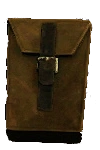
I think I know how it got stuck midair. Sticky fingers are a core mechanic of Dishonored -- You snatch keys, valuables, and letters in pursuit of your goals. The humble belt pouch pictured above is usually how other characters store or carry their shiny coin, ripe to be plucked. In this case, it was called upon to carry a noteworthy note -- a rarer task. Something in that uncommon role, alongside the abrupt and total demise of the wearer, broke the pouch's physics (if it ever had any), and here we are.
This whole ordeal made me think of the sequel, Dishonored 2, a game that expands upon the original in just about every direction, down to the letters. A friend once said the sequel traded in the painterly art style of the original for photorealism, but I thought the difference came down to the level of detail provided by a hulking new game engine. Leave it to Yannick Gombart, environment artist at Arcane Studios, to prove us both right:
"When Dishonored 2 started, the material approach became a little more realistic. We didn’t change how we painted that much, but the PBR [Physically-Based Render] render gave a different look in the shaders. Texel density also increased a lot, and that gave a “more realistic” feeling: our painting patterns became much smaller. So, the biggest challenge was to transform these stylized materials to some more realistic PBR style without betraying our original aesthetic tone."²
What I want to highlight is how Arcane used this new runtime freedom in service of presentation and gameplay. See, the coin pouches return with a fresh model, but we also get a brand new knack to knick:
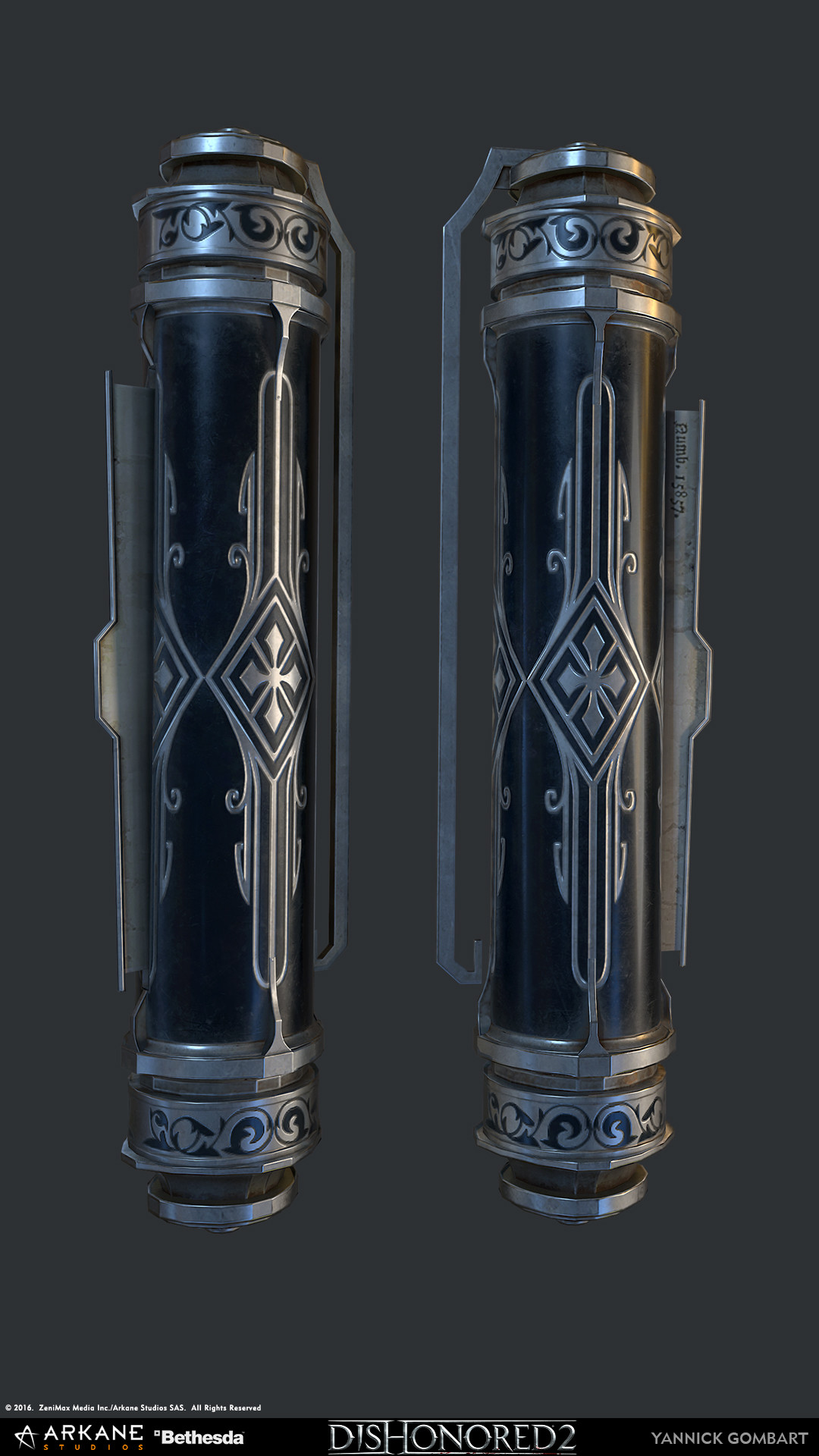
Behold this little scroll tube thingy, modelled by Gombart, designed to safely clip a single document to one's belt. I'd bet high that this only exists to telegraph to the player that an NPC can be tapped for text exposition (either relevant to the mission or the worldbuilding or both). It's so video gamey, yet such attention is put into how it's worn (surprisingly securely for how stealthily you snatch them), the materials used (silver is the wealth of Karnaca, where the game is mostly set), even the typeface for the morsel of exposed text ("Dumb 15857"... not like it's ever legible in-game). Take it from Yannick:
"We like to give love and pay attention to all these props we’re creating because we always want to transcend a basic version and go further. / You’ve probably noticed that many objects have a brand written on it and some have their own ads displayed on the walls of the city! When environment artists receive a concept, there’s already the beginning of a story inside it. Our job is to give life to these drawings: like if they were coming from a real world. / We need to feel that theses object have been used by people. We need a storytelling even in the smallest details, even inside gloss reflections… The atmosphere you find in dishonored is a culmination of all these little details. They give life to this world. We don’t want the players to feel like this world was built for them to play inside. We want them to feel like these cities have their own story and have existed long before their adventure started."²
There you have it. 500+ words on a digital speck, on a gameplay tool dressed up not to look like a gameplay tool. Isn't that neat? You read the whole thing so I assume you think so.
I'll definitely be doing more Dishonored-posting in the future. I'm bigger on the second, but I'll probably start with the first. This feels like a good taste of what that'll entail. Stick around if you dig it, I guess.
¹ Plot-important, though non-essential, given how Dishonored loves to say the same thing seven times for the player's benefit.